
WELCOME BONUS 300%
UP TO €2000 + 100
FREE SPINS
Home → Games
Casino games at Extreme Casino
La Partage Applies Only to Even-Money Bets
French roulette with La Partage carries an RTP of 98.65% and a house edge of 1.35% on even-money bets, and the house edge is the average share of each stake that the casino keeps over the long run. When 0 hits, half the stake on Red/Black, Odd/Even or Low/High is returned; inside bets such as Straight at 35:1, Split at 17:1, Street at 11:1 and Corner at 8:1 receive no such return. On a €100 even-money stake, the expected cost is €1.35 per resolved bet, which sits well below the American wheel's 5.26%. En Prison delivers the same 1.35% figure, and neither version applies outside even-money bets.
The rule cuts the cost of even-money play sharply: €100 staked on Red/Black in French roulette costs €1.35 on average, while the same €100 on an American Red/Black bet costs €5.26. That gap of 3.91 percentage points accumulates across a session, so a player who stakes €1,000 on even-money bets faces roughly €13.50 rather than €52.60 over the long run. Inside bets on the French layout keep the standard 2.70% edge, since La Partage does not reach them.
La Partage does not rescue every bet on the French wheel. A Straight bet at 35:1, a Split at 17:1 or a Corner at 8:1 is priced at the usual European edge of 2.70%, roughly double the 1.35% available on Red/Black, Odd/Even and Low/High. A player who mixes €50 on a Straight with €50 on Red/Black faces a blended cost nearer €2.03 per €100 than €1.35, so concentrating stakes on even-money bets keeps the effective edge at its lowest.
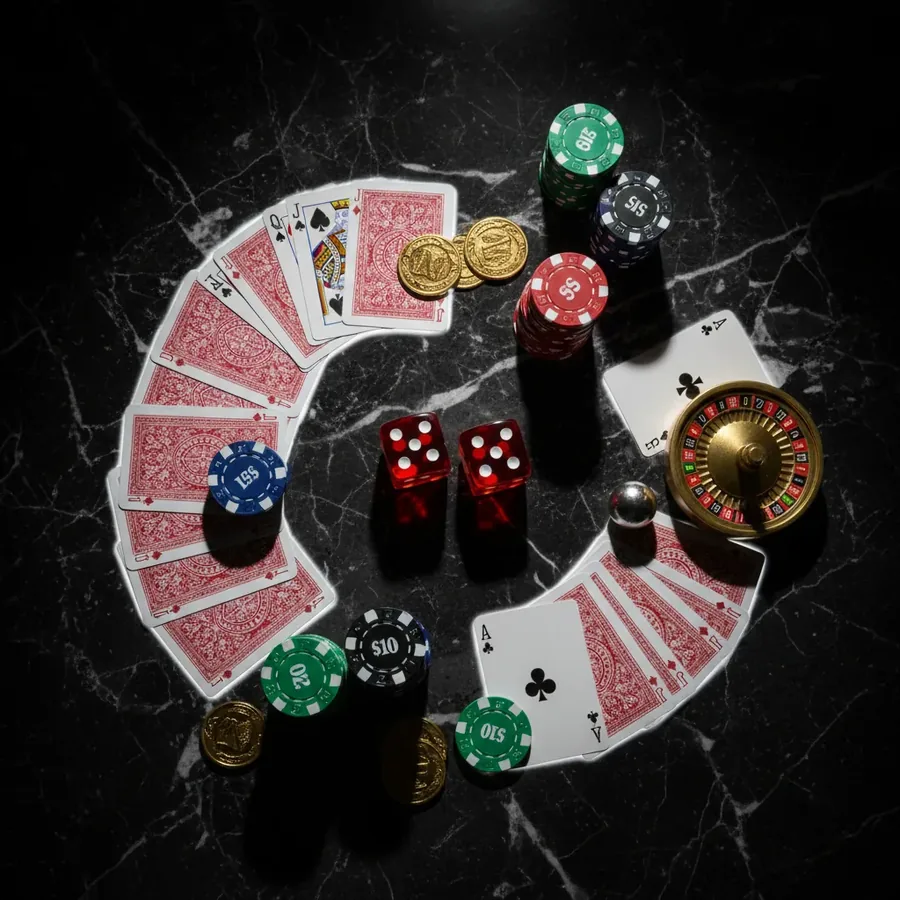
Three Roulette Variants and Their House Edges
The American wheel with double zero holds 38 pockets (1–36 plus 0 and 00) and returns an RTP of 94.74%, giving a house edge of 5.26% against the European wheel's 2.70%. Payouts match the European layout — Straight 35:1, Split 17:1, Street 11:1, Corner 8:1, Six Line 5:1, Dozen 2:1, Column 2:1 and Red/Black 1:1 — but the extra pocket doubles the casino's margin. On €100 of straight-up American bets, the expected cost is €5.26.
The Five Number Bet (0, 00, 1, 2, 3) on the American wheel is the outlier: RTP 92.11%, house edge 7.89%, and a payout of 6:1 covering 5 of 38 pockets. That edge is 2.63 percentage points above the standard 5.26% American figure and has no equivalent on the European wheel. A €20 stake on this bet carries an expected cost of €1.58.
French roulette with La Partage sits at the other end for even-money bets: RTP 98.65% and a house edge of 1.35%, against 94.74% and 5.26% on the American double-zero layout. Staking €200 on Red/Black costs about €2.70 on the French wheel versus €10.52 on the American one. The gap narrows on inside bets, where French roulette pays the standard 2.70% edge.
How a Blackjack Hand Plays Out: Cards, Decisions, 3:2 Payout
A liberal Vegas Strip blackjack table with S17, DAS, resplit and late surrender returns an RTP of 99.72% and a house edge of 0.28%, with a 3:2 payout on blackjack and 1:1 on a regular win. The 3:2 payout means a €10 blackjack returns €15 in profit. Standard deviation on this rule set is 1.15.
The 6-deck, S17, DAS, DOA variant with a 3:2 payout and basic strategy returns RTP 99.54% and a house edge of 0.46%. The 0.18-percentage-point gap against the liberal Vegas Strip set reflects the missing late surrender option. Applying basic strategy is required to reach 99.54%; a €100 total stake costs €0.46 on average under those rules.
Rule modifiers shift the edge further: dealer hits soft 17 (H17) adds 0.22 percentage points, doubling after a split (DAS) removes 0.14 points, resplitting aces removes 0.08 points, and moving from 8 decks to 6 removes about 0.02 points. A €10 blackjack win pays €15 at 3:2, and insurance at 2:1 on a side bet of up to 50% of the main bet carries RTP 92.53% — a side bet that basic strategy always declines.
Multi-Hand Blackjack: Up to 5 Hands
Multihand blackjack lets a player run up to 5 hands against the same dealer, so a €10 base bet across 5 hands puts €50 at risk on one deal. At the 6-deck, S17, DAS, DOA, 3:2 configuration, RTP is 99.54% and the house edge is 0.46%, meaning €50 of total stakes costs about €0.23 across the round.
Splitting can push a single seat beyond 5 hands: a split allows up to 4 hands from one starting pair, and split aces usually receive one card each. Doubling doubles the stake on one card, so a €10 hand becomes €20 on the extra card. Each added hand multiplies the exposure at the same 0.46% edge rather than lowering it.
The liberal Vegas Strip rule set — S17, DAS, resplit and late surrender — returns RTP 99.72% and a house edge of 0.28%, so 5 hands at €10 each carry an expected cost of €0.14 per deal instead of €0.23. Blackjack still pays 3:2 and a regular win 1:1 on every hand. The 0.18-percentage-point difference between the two rule sets is the value of late surrender across a multihand session.
Game categories at a glance
| Category | Examples | Stakes From | Highlight |
|---|---|---|---|
| Slots | Legend of Cleopatra Megaways, Big Bass Bonanza, Money Train 2 | 0.10 EUR | thousands of titles |
| Table games | Roulette, Blackjack, Baccarat | 0.50 EUR | classic rules |
| Live casino | Sweet Bonanza CandyLand, Blaze Roulette | 0.20 EUR | real dealers |
| Jackpot games | Mega Moolah, Divine Fortune, Age of the Gods | 0.20 EUR | progressive pools |
| Instant games | Aviator, Plinko, Mines | 0.10 EUR | fast rounds |
| Video poker | Jacks or Better, Deuces Wild | 0.25 EUR | strategy based |
When Does Splitting Aces and Eights Make Sense?
Resplitting aces improves the return by 0.08 percentage points under the rule effects for Blackjack Split, double and H17, while doubling after a split adds about 0.14 percentage points. Those two modifiers together are worth roughly 0.22 percentage points, the same size as the penalty from a dealer who hits soft 17. A player who ignores them gives that amount back on every 100 € staked.
Split hands reach up to 4 hands in the standard structure, and split aces usually receive one card each. That one-card limit is the reason aces are split less often than eights: a pair of eights against a dealer's ace is a defensive split, while aces gain from the 0.08 percentage point resplit rule only when the table allows it. The base game pays blackjack at 3:2 and a regular win at 1:1.
Dealer hits soft 17 costs 0.22 percentage points of return, so a table with S17 and doubling after a split is worth more than one without. Six decks instead of 8 decks adds about 0.02 percentage points. On a 100 € round the difference between the two configurations is small per hand but accumulates over a session of 200 hands.
Straight-Up, Split and Corner Compared
A straight bet pays 35:1 on the European wheel, a split pays 17:1 and a corner pays 8:1, all inside bets without La Partage protection. French Roulette with La Partage carries an RTP of 98.65% and a house edge of 1.35% on even-money bets, but the rule applies only to Red/Black, Odd/Even and Low/High, so the three inside bets keep the full edge.
Coverage explains the gap: a straight covers 1 pocket, a split covers 2 and a corner covers 4, so the payout falls roughly in proportion to the number of pockets. On a 38-pocket American wheel the same straight still pays 35:1, which lifts the house edge to 5.26% against 2.70% on the European layout. The Five Number bet on that wheel is worse still at 7.89%.
Staking 10 € on a straight, 10 € on a split and 10 € on a corner puts 30 € at risk for a maximum single return of 360 €, 180 € and 90 € respectively. The French table returns half the stake on even-money bets when 0 hits, which is the 1.35% edge, but that protection never reaches the inside bets. En Prison produces the same 1.35% figure.
Split, Double, and Surrender: Three Decisions Explained
Doubling after a split improves the return by about 0.14 percentage points, resplitting aces by 0.08 percentage points, and the two together offset most of the 0.22 percentage point penalty from a dealer who hits soft 17. A six-deck shoe instead of 8 decks is worth another 0.02 percentage points. Those modifiers decide whether a table reaches the 99.54% mark.
Late surrender belongs to the liberal Vegas Strip rule set, which combines S17, DAS, resplitting and late surrender for an RTP of 99.72% and a house edge of 0.28%. That rule set pays blackjack at 3:2 and a standard win at 1:1. The standard 6-deck S17 game with DAS and DOA sits lower at 99.54% and 0.46%, a gap of 0.18 percentage points.
Doubling doubles the stake with one card only, splitting creates up to 4 hands, and surrender folds the hand before the dealer acts. On 100 € of total stakes the difference between 0.28% and 0.46% is 0.18 € per 100 €, which is small per hand but compounds across several hundred decisions. Basic strategy is required to reach the higher figure.
Punto Banco: 5% Commission on Banker Wins
Baccarat Player, 8 decks, carries an RTP of 98.76% and a house edge of 1.24% with a straight 1:1 payout and no commission. That edge is 0.18 percentage points higher than on Banker, so even after the commission is deducted, the Banker side stays the better bet of the two main options. The Player bet has a standard deviation of 0.95.
The commission on Banker wins is 5%, applied to the winning payout, so a 100 € Banker win returns 95 € in profit. The Tie bet at 8:1 is the weakest of the three main wagers, with an RTP of 85.64% and a house edge of 14.36%; on a tie, Banker and Player stakes are returned as a push. Its standard deviation reaches 2.64.
Comparing a 100 € stake on Player and on Tie makes the spread concrete: the Player wager costs 1.24 € on average, while the Tie wager costs 14.36 € on average, a difference of 13.12 € per 100 € staked. The Tie bet also carries the highest volatility of the three at a standard deviation of 2.64 against 0.95 on Player. Banker remains the strongest main bet once the 5% commission is applied.
American Roulette: 5.26% Because of the Double Zero
American Roulette uses a wheel with 38 pockets: the numbers 1 through 36 plus 0 and 00. The extra double zero pocket lifts the house edge to 5.26% and drops the RTP to 94.74%, a gap that shows up on every stake. A player staking €100 across straight bets can expect to lose €5.26 on average over the long run, compared with far less on a single-zero wheel.
Payouts on the American wheel match the European version, so a straight bet still returns 35:1 and a split returns 17:1. Because the same 35:1 covers 38 pockets instead of 37, the true odds of 36:1 are never paid, and the shortfall is exactly where the double zero pocket extracts its share. A €10 straight bet that wins pays €350 instead of the €360 true odds would justify.
One bet on this wheel is worse still: the five number bet covering 0, 00, 1, 2 and 3. It pays 6:1 on five of 38 pockets, which produces an RTP of 92.11% and a house edge of 7.89%, the only American bet above 5.26%. Avoid it, and the rest of the American layout stays consistent with the 5.26% figure.
Game Shows: Sectors, Multipliers and Bet Ranges
Live game shows split the screen into sectors, each carrying its own multiplier, and the bet range on those sectors is what shapes the round. A sector paying 5x or 10x on a stake of €1 returns €5 or €10 when the wheel stops there, while the same stake on a lower sector pays far less. The spread between the top and bottom sectors is the whole point of the format.
Multipliers in these shows work like the fixed odds on a straight bet in roulette, where 35:1 is the ceiling on a single number. A 100x multiplier on a €1 stake returns €100, but the probability attached to that sector is correspondingly small, so the long-run RTP stays below 100%. The RTP figure is a theoretical average over hundreds of thousands of rounds, not a forecast for one session.
Bet ranges on the sectors usually start at around €0.20 and climb to €100 or more per round, which lets a player test the format at low cost before raising stakes. A player who keeps every round at €0.20 and plays 100 rounds has committed €20 in total. The show itself is a live dealer production, so the RTP and the multipliers are set by the studio rather than by the player.
35:1 Instead of 36:1: Where the House Edge Comes From
A straight bet on a 38 pocket wheel pays 35:1 even though 36:1 would be the true odds. That single missing unit is the entire source of the American house edge of 5.26%, and it applies to every inside bet on the layout. On a €10 straight bet, the shortfall is €10 per winning spin relative to true odds.
The same logic runs through the other inside bets. A split pays 17:1, a street 11:1, a corner 8:1 and a six line 5:1, each one unit below the true odds for the pockets covered. Because the payouts never change, the only variable is the number of pockets, and adding 0 and 00 to a 36 number layout is what pushes the edge from 2.70% on a single-zero wheel to 5.26%.
Craps offers a contrast that makes the mechanism visible. The free odds bet pays at true odds, 2:1 on a point of 4 or 10, 3:2 on 5 or 9 and 6:5 on 6 or 8, which gives it an RTP of 100.00% and a house edge of 0.00%. Roulette has no equivalent, so the 35:1 payout on a straight bet is the price of playing the wheel.
House Edge and RTP: Two Sides of the Same Number
The house edge is the average share of each stake the casino keeps, and the RTP is the share returned to players. The two always add up to 100%, so a game with a 5.26% edge has an RTP of 94.74%, and a game with a 0.28% edge has an RTP of 99.72%. Reading one figure tells the player the other.
Blackjack with liberal Vegas Strip rules shows the friendly end of the scale. Its RTP of 99.72% and edge of 0.28% mean that €100 of stakes costs €0.28 on average, provided the player follows the S17, DAS, resplit and late surrender rule set and uses basic strategy. Without that discipline, the same table returns less.
Craps free odds sits at the extreme: an RTP of 100.00% on the odds bet and an edge of 0.00%, because it pays at true odds. Combined with a Pass Line stake in 3-4-5x mode, the overall RTP is 99.63% and the edge is 0.37%. The insurance side bet on six to eight deck blackjack runs the other way, with an RTP of 92.53% and an edge of 7.47%.
Casino Hold'em: Ante Pays Up to 100:1
Casino Hold'em starts with an ante and a decision after the flop: call at twice the ante or fold. The ante pay table tops out at 100:1 for a royal flush, with a straight flush at 20:1, four of a kind at 10:1, a full house at 3:1, a flush at 2:1 and a straight at 1:1. The call bet always pays 1:1.
The average total stake is 2.64 times the ante, which explains why the house edge is 2.16% on the ante but only 0.82% on the actual amount wagered. On a €10 ante, the average commitment is €26.40, and the element of risk of 0.82% applies to that larger figure. The gap between the two numbers is the price of the call.
If the dealer holds less than a pair of fours, the ante is a push and the round ends without a showdown. That rule softens the ante's exposure, and it is why the ante RTP reaches 99.18% on total amount wagered. A player who folds every hand avoids the call but forfeits the ante, which is the worst line available at the table.
Contact
Live - online chat
Banking









Providers












Extreme Casino 2026